
What Is Noindex Tag?
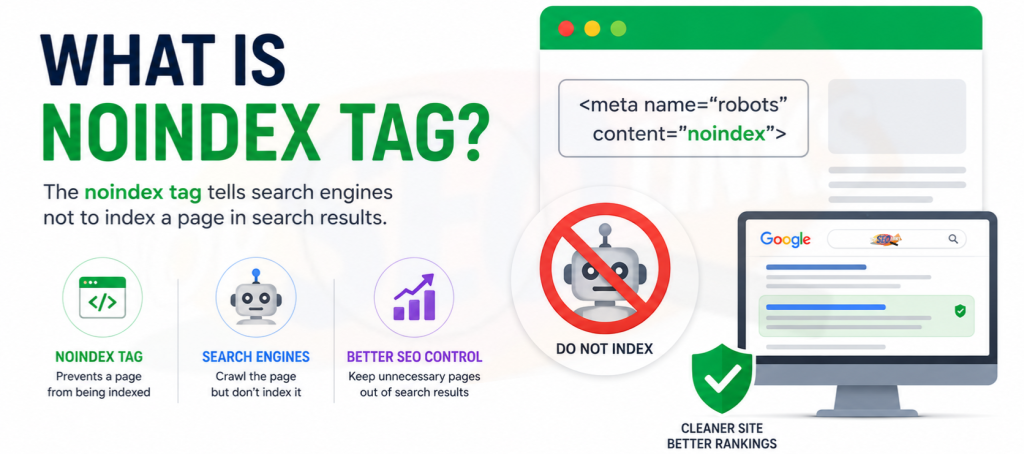
What is noindex tag? A noindex tag is an SEO instruction that tells search engines not to show a page in search results. In simple words, it says, “Please do not index this page.” Website owners use noindex when a page is useful for visitors but not useful for Google search results. For example, login pages, thank-you pages, duplicate pages, thin pages, and private pages may not need to appear on Google.
A noindex tag helps you control which pages search engines can include in their index. Google explains that the noindex rule can be used in a robots meta tag or an X-Robots-Tag HTTP header to stop a page from appearing in search results.
At Topseolinks.com, we help businesses use noindex tags correctly so important pages can rank and low-value pages stay out of search results.
Want to improve your website SEO with expert support? Start with our special offer: Free SEO for 1st Month
What Does Noindex Tag Mean in SEO?
A noindex tag is a small piece of code that gives search engines an instruction. It tells search engines not to add a page to their search index.
A search index is like a big library. Search engines like Google collect web pages and store them in this library. When someone searches something, Google shows pages from this library.
When you add a noindex tag to a page, you are telling Google:
“Do not keep this page in your search library.”
This does not always mean the page is deleted from your website. The page can still exist. Users can still visit it if they have the direct link. But the page should not appear in Google search results after search engines process the noindex instruction.
Here is a simple example:
<meta name="robots" content="noindex">This code is usually added inside the head section of a webpage.
Why Noindex Tag Is Important
Noindex is important because not every page on your website should rank on Google. Some pages are useful for users after they take an action, but they are not useful as search result pages.
For example, a thank-you page after form submission should not appear on Google. A login page should not appear for SEO traffic. A cart page should not rank. Internal search result pages should usually not be indexed.
If search engines index too many low-value pages, your website may look messy. Important pages may not get enough focus. Search engines may spend time crawling and checking pages that do not help your business grow.
A noindex tag helps you:
- Keep low-value pages out of search results
- Improve website quality signals
- Control which pages Google can show
- Reduce duplicate or thin content problems
- Protect private or unnecessary pages from search visibility
- Keep SEO focus on important pages
- Make website indexing cleaner
For a better understanding of how indexing works, you can read What is Indexing in SEO?
How Noindex Tag Works
Noindex works when a search engine crawls the page and reads the noindex instruction.
Here is the simple process:
- Googlebot visits the page.
- Googlebot reads the page code or response header.
- It finds the noindex instruction.
- Google understands that the page should not appear in search results.
- The page is removed from the index or not added to the index.
This is why the page must be crawlable for Google to see the noindex tag. If you block the page in robots.txt, Google may not be able to crawl the page and may not see the noindex instruction. Google’s documentation explains that robots meta tags and X-Robots-Tag rules are discovered when Google crawls the URL.
So, noindex is not the same as blocking crawling. Noindex controls indexing. Robots.txt controls crawling.
Simple Example of Noindex Tag
A noindex tag looks small, but it can have a big SEO impact.
Example:
<meta name="robots" content="noindex">This tells all search engine robots not to index the page.
You can also write:
<meta name="googlebot" content="noindex">This tells only Googlebot not to index the page.
Most websites use the general robots version because it applies to search engines that support the rule.
Noindex Tag vs Nofollow Tag
Many people confuse noindex and nofollow. Both are robots instructions, but they do different jobs.
Noindex means: “Do not show this page in search results.”
Nofollow means: “Do not follow the links on this page.”
You can use them separately or together.
Example:
<meta name="robots" content="noindex, nofollow">This means search engines should not index the page and should not follow links on the page.
But you should use nofollow carefully. In many cases, you may want a page to be noindexed but still allow search engines to follow links from that page. For that, you can use:
<meta name="robots" content="noindex, follow">However, search engines may treat instructions differently over time, so the best option depends on your page purpose and SEO strategy.
Noindex Tag vs Robots.txt
Noindex and robots.txt are not the same. This is one of the most common SEO mistakes.
Robots.txt tells search engines whether they are allowed to crawl a page or folder. Noindex tells search engines whether a page should appear in search results.
| Feature | Noindex Tag | Robots.txt |
|---|---|---|
| Main job | Stops a page from appearing in search results | Blocks or allows crawling |
| Where it is used | Page code or HTTP header | Robots.txt file |
| Best for | Pages that should not rank | Pages or files that should not be crawled |
| Search engine needs to crawl? | Yes, to see the noindex tag | No, robots.txt can stop crawling |
| Common mistake | Adding it to important pages | Blocking a page that needs noindex to be seen |
A simple way to understand this:
- Noindex says: “Do not show this page on Google.”
- Robots.txt says: “Do not visit this page.”
If you block a page with robots.txt, Google may not see the noindex tag. MDN also notes that crawlers need access to a resource to read meta elements and headers.
Noindex Tag vs Canonical Tag
A noindex tag and a canonical tag are also different.
A canonical tag tells search engines which page is the main version when duplicate or similar pages exist. A noindex tag tells search engines not to show the page in search results.
Use canonical when:
- Two pages are similar
- You want one main version to rank
- Duplicate pages should still pass signals to the main page
- Product variations or filter pages are similar
Use noindex when:
- A page should not appear in search results at all
- The page is thin or low value
- The page is private or unnecessary for search
- The page is useful only after user action
For example, if two product URLs show the same product, canonical may be better. But if a thank-you page appears after a form submission, noindex is better.
Where Can You Add a Noindex Tag?
You can add noindex in two main ways.
Meta Robots Tag
This is the most common method. You add the noindex tag inside the head section of the page.
Example:
<meta name="robots" content="noindex">This is useful for normal web pages like blog pages, landing pages, thank-you pages, tag pages, and search result pages.
X-Robots-Tag HTTP Header
An X-Robots-Tag is added in the HTTP header. It is often used for non-HTML files like PDFs, images, videos, or other file types.
Example:
X-Robots-Tag: noindexGoogle supports robots meta tags and X-Robots-Tag HTTP headers for controlling indexing and serving rules.
This method may need developer support because it is handled at the server level.
When Should You Use a Noindex Tag?
A noindex tag should be used when a page should exist for users but should not appear in search results.
Here are common examples:
Thank-You Pages
A thank-you page appears after a user submits a form, buys a product, downloads a file, or signs up.
Example: /thank-you/
This page does not need to rank on Google. It is only useful after a user completes an action.
Login Pages
Login pages are useful for users but not useful for search traffic.
Example: /login/
/my-account/
These pages usually should not appear in search results.
Cart and Checkout Pages
Ecommerce cart and checkout pages should not be indexed.
Example: /cart/
/checkout/
These pages are private user journey pages, not SEO landing pages.
Internal Search Result Pages
If your website has a search box, it may create internal search result pages.
Example: /?s=seo+tips
These pages are often thin, repeated, or low value. Many websites noindex internal search results to avoid indexing unnecessary pages.
Duplicate or Thin Pages
Some pages may have very little content or very similar content.
Example:
- Tag pages with only one post
- Archive pages with repeated content
- Filter pages with no unique value
- Printer-friendly versions
- Old campaign landing pages
Noindex can help keep these pages out of Google search results.
Staging or Test Pages
Staging pages are used for testing a website before it goes live.
Example: staging.example.com
dev.example.com
These pages should not appear in search results because they may contain unfinished content.
Private or Low-Value Pages
Some pages are not meant for public search visibility.
Examples:
- Admin pages
- Policy confirmation pages
- Temporary pages
- Download confirmation pages
- User profile pages
These pages can be useful but not suitable for search results.
Before using noindex, it is important to understand whether the page should stay visible in Google or stay hidden from search results. Pages like thank-you pages, login pages, cart pages, checkout pages, and internal search result pages usually do not need to appear in search results.
When You Should Not Use a Noindex Tag
Noindex is powerful, so it must be used carefully. If you add noindex to the wrong page, that page may disappear from search results.
Do not use noindex on important SEO pages such as:
- Homepage
- Main service pages
- Product pages you want to rank
- Blog posts that bring traffic
- Category pages that target keywords
- Location pages made for SEO
- Important landing pages
- Pages with backlinks and traffic
For example, if your SEO service page has a noindex tag by mistake, it may not appear in Google. That can reduce leads, traffic, and sales.
Before adding noindex, always ask:
- Do I want this page to rank?
- Does this page bring traffic?
- Does this page target an important keyword?
- Does this page have backlinks?
- Is this page useful for new visitors from Google?
- Is this page included in my sitemap?
If the answer is yes, do not add noindex without proper review.
Common Pages That May Need Noindex
| Page Type | Should It Usually Be Noindexed? | Reason |
|---|---|---|
| Thank-you page | Yes | It is only useful after a form or purchase action |
| Login page | Yes | It does not help search users |
| Cart page | Yes | It is part of the private buying process |
| Checkout page | Yes | It should not appear in search results |
| Internal search results | Usually yes | These pages can create many thin URLs |
| Main service page | No | It should rank for business keywords |
| Important blog post | No | It can bring organic traffic |
| Product page | Usually no | It may bring buyers from search |
| Staging page | Yes | It is not meant for public search |
| Duplicate filter page | Usually yes | It may not have unique SEO value |
How to Check If a Page Has a Noindex Tag
You can check a noindex tag in different ways.
View Page Source
Open the page in your browser. Right-click and select “View Page Source.” Then search for:
noindexIf you find a meta robots tag with noindex, the page is telling search engines not to index it.
Use Browser Inspect Tool
Right-click on the page and click “Inspect.” Then check the head section of the page.
Look for: <meta name=”robots” content=”noindex”>
Use Google Search Console
Google Search Console can show whether a page is excluded because of noindex.
You may see messages like:
- Excluded by ‘noindex’ tag
- URL is not on Google
- Page is not indexed
The URL Inspection tool can help you check the status of a specific URL.
Use SEO Audit Tools
SEO tools can crawl your website and find noindex pages. This is helpful for large websites because checking every page manually takes too much time.
Topseolinks.com uses SEO audits to find pages that are noindexed by mistake, pages that should be noindexed, and pages that need better index control.
How to Add a Noindex Tag
Adding a noindex tag depends on your website platform.
Add Noindex in HTML
For a normal HTML page, add this code in the head section:
<meta name="robots" content="noindex">Example:
<head>
  <title>Thank You</title>
  <meta name="robots" content="noindex">
</head>
Add Noindex in WordPress
In WordPress, many SEO plugins allow you to noindex a page.
Common steps:
- Open the page or post.
- Go to the SEO plugin settings.
- Find the advanced settings.
- Choose “No” for allowing search engines to show the page.
- Update the page.
- Check the page source to confirm the noindex tag is added.
Add Noindex for PDF or File URLs
For non-HTML files like PDFs, you may need to use X-Robots-Tag in the HTTP header.
Example:
X-Robots-Tag: noindexThis usually needs developer or hosting support.
Remove Noindex From Important Pages
If a page should rank but has noindex, remove the noindex tag.
After removing it:
- Check the page source
- Submit the URL in Google Search Console
- Update your XML sitemap
- Make sure the page is internally linked
- Wait for Google to recrawl the page
How Long Does Noindex Take to Work?
Noindex does not always work instantly. Search engines need to crawl the page again and read the noindex instruction.
If the page is already indexed, it may take some time before it disappears from search results. The time depends on how often Google crawls your website.
Important pages may be recrawled faster. Low-traffic pages may take longer.
To speed up the process, you can:
- Submit the URL in Google Search Console
- Link to the page from crawlable pages
- Keep the page accessible to crawlers
- Avoid blocking it in robots.txt
- Make sure the noindex tag is visible in the page source
Noindex Tag Mistakes to Avoid
Noindex mistakes can hurt SEO. A small mistake can remove important pages from search results.
Adding Noindex to Important Pages
This is one of the biggest mistakes. Sometimes a website redesign or plugin setting can accidentally add noindex to the whole website.
This can remove important pages from search results.
Always check:
- Homepage
- Service pages
- Product pages
- Blog pages
- Category pages
- Location pages
Blocking Noindex Pages in Robots.txt
If you block a page in robots.txt, Google may not be able to crawl the page and see the noindex tag. This can stop the noindex instruction from being processed properly.
Leaving Noindex on Staging Pages After Launch
Many developers add noindex to staging websites. That is correct during testing. But after the website goes live, they may forget to remove it.
This can stop the live website from ranking.
Using Noindex Instead of Canonical
If two pages are similar and one should pass SEO signals to another, canonical may be better than noindex.
Noindex removes the page from search results. Canonical tells search engines which page is preferred.
Adding Noindex Through Multiple Places
Sometimes a noindex tag can come from:
- SEO plugin
- Theme setting
- CMS setting
- Server header
- Developer code
- Staging configuration
This can make the issue harder to find. That is why a full SEO audit is helpful.
How Noindex Helps Website SEO
Noindex helps SEO by keeping search results clean. It tells search engines to focus on the pages that matter.
When used correctly, noindex can improve:
- Index quality
- Crawl efficiency
- Website structure
- Search result control
- Duplicate content management
- Thin content control
- SEO focus on important pages
For example, if your website has 1,000 pages but only 300 are useful for search, noindex can help keep unnecessary pages out of the index.
This does not mean you should noindex many pages without checking. The goal is not to hide everything. The goal is to keep only valuable search pages indexable.
How Topseolinks.com Helps With Noindex Tag Issues
Noindex tag problems can be simple or serious. Sometimes a website owner only needs to noindex a thank-you page. Other times, an entire website may lose traffic because important pages were noindexed by mistake.
Topseolinks.com helps businesses manage noindex tags with a careful SEO process.
We Check Your Website Indexing
We review which pages are indexed, not indexed, blocked, redirected, canonicalized, or noindexed. This helps us understand your website’s search visibility.
We Find Wrong Noindex Tags
Sometimes important pages have noindex by mistake. We find these pages and help remove the tag safely.
We Find Pages That Should Be Noindexed
Some pages should not appear in Google. We help identify low-value pages, duplicate pages, internal search pages, thin pages, and private pages that may need noindex.
We Improve Technical SEO
Noindex is part of technical SEO. We check robots.txt, meta robots tags, X-Robots-Tag headers, canonical tags, sitemap files, internal links, and crawl paths.
Our SEO Services help businesses improve website health, rankings, and long-term search performance.
We Help You Avoid SEO Mistakes
Noindex should be used with care. At Topseolinks.com, we help you make the right choice between noindex, canonical tags, redirects, and content improvements.
For businesses that need expert help regularly, you can also Hire Dedicated SEO Expert to manage technical SEO, indexing issues, and ongoing website growth.
Simple Noindex Tag Checklist
Use this checklist before adding or removing a noindex tag:
- Check if the page should appear in Google
- Check if the page targets an important keyword
- Check if the page gets traffic
- Check if the page has backlinks
- Check if the page is included in sitemap
- Check if robots.txt is blocking the page
- Check if a canonical tag is a better option
- Check if the page is thin, duplicate, or private
- Check page source after adding noindex
- Check Google Search Console after changes
- Review your noindex pages regularly
Noindex Tag Best Practices
Use noindex only when it has a clear purpose.
Good noindex practice means:
Keep Important Pages Indexable
Your main business pages should not have noindex. These pages help bring traffic, leads, and sales.
Use Noindex for Low-Value Search Pages
Use noindex for pages that do not help search users, such as thank-you pages, login pages, and internal search pages.
Do Not Mix Robots.txt Block With Noindex
Let search engines crawl the page so they can see the noindex tag.
Review Website After Redesign
After launching a redesigned website, check for accidental noindex tags. This is very important.
Keep Sitemap Clean
Your sitemap should usually include only important indexable pages. Do not keep noindexed pages in your main sitemap for a long time unless there is a specific temporary reason.
Monitor Google Search Console
Google Search Console helps you see which pages are excluded by noindex. Check it regularly.
Make Your Website Indexing Clean and SEO-Friendly
A noindex tag is a useful SEO tool when used correctly. It tells search engines not to show certain pages in search results. This helps keep your website clean, focused, and easier for search engines to understand.
The main thing to remember is simple:
Use noindex for pages that should exist but should not rank.
Do not use noindex on pages that bring traffic, leads, sales, or important keyword rankings.
At Topseolinks.com, we help businesses manage noindex tags, indexing problems, technical SEO errors, and website ranking issues. Whether your website has wrong noindex tags, too many low-value pages, or indexing problems in Google Search Console, our team can help you fix them properly.
Ready to improve your website indexing and SEO performance? Contact Us
FAQs
What is noindex tag in SEO?
A noindex tag is an instruction that tells search engines not to show a page in search results. The page can still exist on your website, but it should not appear on Google after search engines process the tag.
Where is the noindex tag placed?
A noindex tag is usually placed in the head section of a webpage as a meta robots tag. It can also be added through an X-Robots-Tag HTTP header for files like PDFs or other non-HTML resources.
Does noindex remove a page from Google?
Yes, noindex can remove a page from Google search results after Google crawls the page and reads the noindex instruction. It may take some time because Google needs to revisit the page first.
Is noindex the same as robots.txt?
No, noindex and robots.txt are different. Noindex tells search engines not to show a page in search results. Robots.txt tells search engines whether they can crawl a page or folder.
Should I use noindex on duplicate pages?
Sometimes, but not always. If a duplicate page should not appear in search results, noindex may help. But if you want to pass SEO signals to the main version, a canonical tag may be a better option.
Can noindex hurt SEO?
Yes, noindex can hurt SEO if it is added to important pages by mistake. If your homepage, service pages, product pages, or useful blog posts have noindex, they may not appear in search results.
How can I check if a page has noindex?
You can check the page source and search for “noindex.” You can also use Google Search Console, browser inspect tools, or SEO audit tools to find pages with noindex tags.
Can Topseolinks.com help fix noindex tag issues?
Yes. Topseolinks.com can audit your website, find wrong noindex tags, fix indexing issues, improve technical SEO, clean your sitemap, and help important pages appear properly in search results.