
What Is HTTPS SEO Impact?
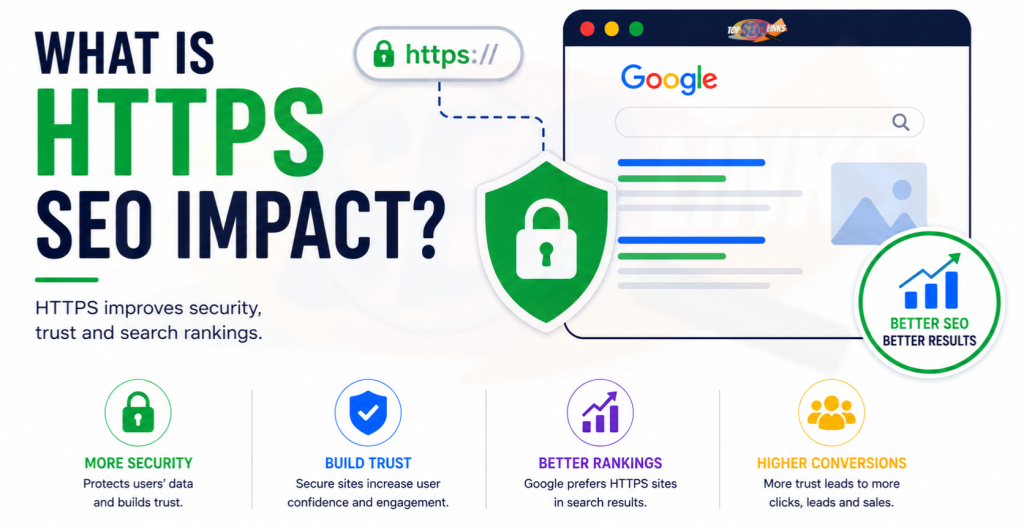
HTTPS SEO impact means how a secure website connection can affect your website’s trust, user experience, and search engine performance. HTTPS helps protect the information shared between a user’s browser and your website. It also shows visitors that your website is safer to use.
When a website uses HTTPS, the website address usually starts with https:// instead of http://. This small “s” stands for secure. It means the website is using security protection, often through an SSL certificate.
For a business website, HTTPS is very important. Users may not feel safe on a website that shows “Not secure” in the browser. Google Search Central has confirmed that HTTPS is a ranking signal, and Google Chrome also shows security status for websites in the browser.
At Topseolinks.com, we help businesses improve website SEO, technical structure, user trust, and website performance. A secure website is not just good for safety; it also supports a better SEO foundation.
Start improving your website with Topseolinks.com’s Free SEO for 1st Month offer and build a stronger base for search visibility.
What Does HTTPS Mean?
HTTPS stands for Hypertext Transfer Protocol Secure. In simple words, it is a safer way for a browser and a website to talk to each other.
When someone visits your website, their browser sends and receives information. This may include names, phone numbers, email addresses, login details, payment details, or form messages. HTTPS helps protect this information so it is harder for others to steal or change it.
HTTP vs HTTPS
| Point | HTTP | HTTPS |
|---|---|---|
| Security | Not secure | Secure |
| Website address | Starts with http:// | Starts with https:// |
| Data protection | Weak protection | Stronger protection |
| User trust | Lower trust | Higher trust |
| SEO support | Not preferred | Better SEO foundation |
HTTPS is now a basic need for most websites, especially business websites, eCommerce websites, service websites, blogs, and websites that collect user information.
Why HTTPS Matters For SEO
HTTPS matters for SEO because search engines want to show websites that are useful, safe, and trustworthy. If two pages are similar in quality, a secure page may have a better chance than a non-secure page because HTTPS is one of Google’s ranking signals.
But HTTPS alone will not make a weak website rank on top. It works as one part of a bigger SEO plan. Your website still needs helpful content, fast loading speed, mobile friendliness, technical SEO, internal linking, quality backlinks, and a good user experience.
This is why HTTPS should be seen as a strong foundation, not a magic ranking button.
Main HTTPS SEO Benefits
- It helps build user trust.
- It supports better website security.
- It can help search engines see your website as safer.
- It protects form and login data.
- It avoids “Not secure” browser warnings.
- It supports technical SEO health.
- It helps create a better experience for visitors.
How HTTPS Builds Website Trust
Trust is very important online. When users visit a website, they want to feel safe. If the browser shows a warning or says the site is not secure, visitors may leave quickly.
This can hurt your business because users may not fill out forms, call your company, buy products, or share details.
HTTPS helps create a safer feeling. It tells users that your website has a secure connection. This is especially important for:
- Contact forms
- Login pages
- Payment pages
- Checkout pages
- Appointment booking forms
- Newsletter signups
- Service inquiry forms
When users trust your website, they are more likely to stay longer and take action.
HTTPS And User Experience
User experience means how easy and comfortable your website feels for visitors. A secure website gives users more confidence while browsing.
If your website is not secure, some users may stop before they even read your content. Browser warnings can make people feel worried. This can increase bounce rate and reduce leads.
A good user experience includes:
- Secure browsing
- Fast page loading
- Easy navigation
- Clear design
- Simple forms
- Mobile-friendly pages
- Trust signals
HTTPS is one part of this full experience. It helps users feel that your website is professional and serious.
For businesses that want better search performance, Topseolinks.com’s SEO Services can help improve technical SEO, website trust, content structure, and ranking opportunities.
Does HTTPS Directly Improve Rankings?
HTTPS can help SEO because Google uses it as a ranking signal. But it is not the biggest ranking factor. A secure website with poor content may still not rank well. A secure website with slow pages, bad structure, or duplicate content may also struggle.
Think of HTTPS like a strong lock on your shop door. The lock is important, but your shop also needs good products, clean shelves, helpful staff, and clear signs.
In the same way, HTTPS is important, but your website also needs:
- Useful content
- Good keywords
- Fast loading speed
- Mobile-friendly design
- Proper title tags
- Clean URLs
- Internal links
- Technical SEO fixes
- Quality backlinks
- Clear user journey
HTTPS Impact On Different SEO Areas
| SEO Area | How HTTPS Helps | Why It Matters |
|---|---|---|
| Rankings | Works as a ranking signal | Supports SEO strength |
| Trust | Shows secure connection | Users feel safer |
| Conversions | Reduces fear on forms and payments | More people may take action |
| Technical SEO | Creates a cleaner secure setup | Helps site health |
| User experience | Avoids security warnings | Reduces user hesitation |
HTTPS should be part of every serious SEO strategy. It may not replace content or backlinks, but it improves the base on which your SEO grows.
What Is An SSL Certificate?
An SSL certificate is a security certificate that helps create HTTPS on your website. It protects the connection between the website and the visitor’s browser.
Without an SSL certificate, your website may open on HTTP. With a properly installed SSL certificate, your website can open safely on HTTPS.
A website with an SSL certificate helps protect:
- Personal details
- Login information
- Contact form data
- Payment information
- User messages
- Account details
For business websites, this is very important because customers expect safety. If your site collects any type of information, HTTPS should be active.
The topic of SSL and rankings is closely connected with secure website performance.
HTTPS And Technical SEO
HTTPS is also a technical SEO topic. Technical SEO means improving the parts of a website that help search engines crawl, index, and understand the website better.
If HTTPS is not set up correctly, it can create SEO problems. For example, your website may have both HTTP and HTTPS versions live at the same time. This can confuse search engines and create duplicate versions of pages.
Common HTTPS Technical Problems
- HTTP pages are still opening.
- HTTPS pages are not redirecting correctly.
- Mixed content is loading on pages.
- SSL certificate is expired.
- Some images or scripts still load from HTTP.
- Sitemap has old HTTP URLs.
- Internal links still use HTTP.
- Canonical tags point to HTTP pages.
- Search Console property is not updated.
These problems can reduce the benefits of HTTPS. That is why HTTPS migration and checking should be done carefully.
For a deeper understanding of website health, crawling, indexing, and secure structure, technical SEO plays an important role.
What Is Mixed Content?
Mixed content happens when your main page opens with HTTPS, but some images, scripts, videos, fonts, or files still load from HTTP.
For example, your page may be: https://example.com/service-page

But one image on that page may still load from: http:// example.com/image.jpg
This can create security warnings or break parts of the page. It also shows that the HTTPS setup is not fully clean.
How To Fix Mixed Content
You can fix mixed content by:
- Updating image URLs from HTTP to HTTPS.
- Updating script and CSS links.
- Checking theme files.
- Checking plugin files.
- Using proper redirects.
- Updating database URLs if needed.
- Testing pages after changes.
Mixed content is common after moving from HTTP to HTTPS, especially on old websites.
HTTPS Migration: What Website Owners Should Check
Moving from HTTP to HTTPS is called HTTPS migration. It sounds simple, but if it is done carelessly, SEO problems can happen.
Search engines need to understand that your old HTTP pages have moved to HTTPS pages. This is usually done with 301 redirects. After migration, your main website URL, internal pages, sitemap, and canonical tags should all point to the secure version of your website.
For example, the Topseolinks.com uses HTTPS, which helps create a secure and trusted starting point for users and search engines.
HTTPS Migration Checklist
| Task | Why It Is Important |
|---|---|
| Install SSL certificate | Enables HTTPS |
| Redirect HTTP to HTTPS | Sends users and search engines to secure pages |
| Update internal links | Keeps website structure clean |
| Update canonical tags | Shows preferred secure URLs |
| Update sitemap | Helps search engines find HTTPS URLs |
| Fix mixed content | Avoids browser security issues |
| Check robots.txt | Makes sure important pages are crawlable |
| Verify in Search Console | Helps monitor search performance |
| Test forms and checkout | Confirms users can submit data safely |
A proper HTTPS migration protects your SEO value and gives users a safer browsing experience.
HTTPS And Website Conversions
Conversions mean the actions you want users to take. This may include calling your business, filling out a form, buying a product, booking a service, or requesting a quote.
HTTPS can support conversions because users feel safer. If a visitor sees a “Not secure” warning, they may not enter personal details. This can reduce leads and sales.
HTTPS is especially important for:
- eCommerce websites
- Lead generation websites
- Local business websites
- Healthcare websites
- Finance websites
- Education websites
- Login-based websites
- Membership websites
Even if your website is only a simple business website, HTTPS still matters because trust matters.
HTTPS And Mobile SEO
Many users visit websites from mobile phones. On mobile, trust and speed are very important. If a mobile visitor sees a browser warning, they may leave immediately.
HTTPS supports mobile SEO because it helps create a safer and more reliable browsing experience. But your website should also be mobile-friendly, fast, and easy to use.
A secure mobile website should have:
- HTTPS active on all pages
- Fast loading speed
- Easy-to-read text
- Simple navigation
- Secure forms
- Tap-friendly buttons
- No broken layout
- No mixed content warnings
HTTPS and mobile usability work together to create a better experience.
Does HTTPS Make A Website Faster?
HTTPS itself does not automatically make every website faster. But modern HTTPS setups can work well with newer web technologies that improve speed and performance.
Website speed still depends on many things, such as hosting, image size, code quality, caching, theme, plugins, and server setup.
If your website becomes slow after HTTPS setup, it may mean something is configured incorrectly. A proper technical check can help find the issue.
Common HTTPS SEO Mistakes To Avoid
Many websites install an SSL certificate but do not complete the full SEO setup. This can create hidden problems.
Avoid These Mistakes
- Do not keep HTTP and HTTPS versions active separately.
- Do not forget 301 redirects.
- Do not leave internal links with HTTP.
- Do not use an expired SSL certificate.
- Do not ignore mixed content.
- Do not forget to update XML sitemap.
- Do not point canonical tags to HTTP pages.
- Do not forget to test contact forms.
- Do not ignore browser warnings.
- Do not skip Search Console checks.
These small mistakes can affect crawling, indexing, trust, and user experience.
How Topseolinks.com Can Help With HTTPS SEO Impact
Topseolinks.com helps businesses build a stronger SEO foundation. HTTPS is not just a security setting; it is part of technical SEO, trust, user experience, and website quality.
Our team can help identify issues that may affect your HTTPS SEO impact, such as redirect problems, mixed content, weak technical structure, poor page experience, and outdated internal links.
Topseolinks.com can help with:
- HTTPS SEO checks
- SSL-related SEO review
- Technical SEO audit
- Redirect issue checking
- Mixed content issue suggestions
- Internal linking improvement
- Website structure review
- Mobile and page experience guidance
- Search Console issue analysis
- SEO content planning
If your website also needs a cleaner, more professional layout, Our Web Design Services can help create a better user experience with a secure and SEO-friendly website design.
Best Practices For HTTPS SEO
To get the best SEO value from HTTPS, your website should follow clean and simple best practices.
Important HTTPS SEO Best Practices
- Use a valid SSL certificate.
- Make sure every page opens with HTTPS.
- Redirect all HTTP pages to HTTPS.
- Update all internal links.
- Fix mixed content errors.
- Update sitemap URLs.
- Use HTTPS in canonical tags.
- Check website in Google Search Console.
- Test important forms.
- Renew SSL certificate on time.
- Keep plugins, themes, and CMS updated.
- Monitor website after migration.
HTTPS is not something you should set once and forget forever. It should be checked from time to time, especially after website redesigns, plugin changes, hosting changes, or SEO audits.
Secure Your Website SEO Foundation With Topseolinks.com
HTTPS has a clear impact on SEO because it supports website security, user trust, technical health, and search engine confidence. It is not the only ranking factor, but it is an important part of a strong SEO foundation.
A secure website helps visitors feel safe. It also helps your business look professional. When HTTPS is combined with good content, fast speed, mobile-friendly design, and technical SEO, your website becomes stronger for both users and search engines.
If your website has HTTPS errors, SSL issues, mixed content warnings, poor technical SEO, or low search visibility, Topseolinks.com can help you improve your website step by step.
Ready to make your website secure, SEO-friendly, and easier for users to trust?
Contact Us today and let Topseolinks.com help you build a stronger website foundation.
FAQs
What is HTTPS SEO impact?
HTTPS SEO impact means how HTTPS affects your website’s search performance, trust, security, and user experience. HTTPS helps protect user data and supports a safer website experience.
Does HTTPS help SEO rankings?
Yes, HTTPS can help SEO because Google uses it as a ranking signal. But HTTPS alone is not enough. Your website also needs helpful content, fast speed, mobile friendliness, and strong technical SEO.
What happens if my website is not HTTPS?
If your website is not HTTPS, browsers may show a “Not secure” warning. This can reduce user trust and may stop people from filling forms, buying products, or contacting your business.
Is SSL certificate important for SEO?
Yes, an SSL certificate is important because it helps enable HTTPS. HTTPS supports website security, trust, and technical SEO health.
Can HTTPS fix all SEO problems?
No, HTTPS cannot fix all SEO problems. It is only one part of SEO. You still need good content, proper keywords, fast pages, mobile-friendly design, backlinks, and technical SEO fixes.
How can Topseolinks.com help with HTTPS SEO?
Topseolinks.com can help with HTTPS SEO checks, technical SEO audits, mixed content review, redirect issue checking, internal linking improvement, and overall website SEO planning.